
Overview
The benefits of using 3D models in construction are multitude; they allow for better visualization, early identification of potential problems, improved communication between teams, and more accurate cost estimations, ultimately leading to a more efficient and streamlined building process.
Fieldwire's 3D models tab includes several ways to interact with your 3D models, such as filtering for specific types of items to display when you're viewing the model, combining all of the models in your project into one view, or interacting with each 3D model separately. We continue to evolve this feature, so your feedback is appreciated!
The Federated and Tiled Views
By default, your 3D models will appear as one single model for you to view and interact with. This is called the federated view, and you can toggle between this and the tiled view via the cube icon in the upper right corner of your screen.
Note: The federated view supports 20 models to optimize performance.
When you first select the federated view, it may take a few moments for the system to collate the models. Here's an example of how it looks:
The tiled view provides a way to see and interact with each 3D model you've uploaded, independent from each other. Click on a specific 3D model to open it and utilize the tools detailed below, or organize the 3D models into separate folders as needed with the "New folder" option in the top left. You can upload new 3D models in both views.
Note: You can now view multiple trade models in a single view to quickly spot layout differences, improve sequencing, and catch potential clashes early.
Note: If you receive this warning after uploading your 3D models, it is most likely caused by uneven levelling. These models will then need to be recalibrated at the same level by the company responsible for creating and exporting the models.
If you have connected and calibrated your 2D plans with a 3D model, you'll be able to easily go between the two. To do so:
- Right click on the plan sheet
- Click View in 3D
- Note: If you don't see this option, then you have not calibrated and connected that plan sheet with your 3D models
OR
- Select the cube icon shown in the screenshot below
- Note: If you don't see this icon, then you have not calibrated and connected that plan sheet with your 3D models
- Click the area on the plan sheet that you want to view in 3D
From there, you'll be redirected to the 3D model.
Once you are finished viewing the 3D model, navigate back to the plan by clicking the back arrow with the name of the plan sheet.
Cut Sections (Scissors Icon)
After you upload your 3D model to Fieldwire, you will be able to utilize the cut sections feature. Cut sections is used to more easily navigate the model and get to the view that provides users with the information they need to complete the job. It can provide a way to view inside walls or slabs, without hiding any of the surrounding objects in the model, so that the layout is very clear.
To use the cut sections button:
- Click on the scissors icon
- Hover your cursor over the model
- At this point, a blue, transparent box with the text "click model to add cut" will appear.
- Select the section of the model you would like to cut
- After selecting the section, a tool will appear with blue, green, and red arrows that assist in moving the plane in Fieldwire as well as determining what section of the model you will be cutting.
3D Snapshot
You can capture a snapshot of your current BIM Viewer scene and save it directly to your project's Photos tab for quick reference and collaboration. The snapshot feature is available in the Federated View only.
A 3D snapshot captures exactly what is visible in your scene at that moment, including:
Visible measurements
Task pins
Active cut sections
Hidden/shown objects
The following UI elements are not captured in the snapshot:
Navbar buttons
Navigation cube
Object Tree menu
Cut Section menu or tool plane
Tasks sidebar
Viewer borders
To create a 3D snapshot:
Navigate to the 3D Models tab and open the Federated View.
Set up your scene as needed (apply cut sections, hide/show objects, position measurements or tasks).
Click the 3D Snapshot option in the viewer toolbar.
A camera flash effect will display, confirming the image was saved.
A temporary notification will appear: "Snapshot saved to photos."
A modal will open showing the captured image.
The snapshot is saved to your project's Photos tab and links back to the Federated View viewpoint where it was taken.
Object Tree (Eyeball Icon)
The object tree is an interactive hierarchy that comes from the IFC file itself. It is a hierarchal list of all of the objects contained in the model organized in two ways: by 'Story' or by 'Class'. You can easily toggle objects to show or hide ones in certain areas (stories) or of certain types (classes). This will help you to find the objects and information about them more quickly. For example, if you have a 20 story building and only need to see the doors on the 5th floor, or only all of the pipes and fittings, you can easily hide the rest of the model to locate these objects.
Home Button
The 'Home' option will return you to the 'Default View'. This will expose any objects that were previously hidden, and unselect anything you had previously selected.
Choosing the 'Home' option is the best way to return to where you started:
Orbit and Walk Tools
The Orbit tool is the default, but you can click on the button to change it to the Walk (looks like two footprints) tool.
Note: Only 1 tool can be selected at a time. If you upload 21 or more models to the 3D module, calibration is disabled.
The Orbit Tool
Selecting the Orbit Tool allows a user to click anywhere on the model and drag to rotate the model.
To Rotate:
| Mouse | Trackpad |
| Left Click + Drag (Up/Down/Left/Right) | Press + Drag w/ 1 finger (Up/Down/Left/Right) |
To Pan:
| Mouse | Trackpad |
|
r Or Shift Key + Left Click & Drag (Up/Down/Left/Right) |
Right Click & Drag Or Shift Key + Drag w/ 1 finger (Up/Down/Left/Right) |
To Zoom In/Out:
| Mouse | Trackpad |
| Scroll Mouse Wheel Up/Down | Swipe w/ 2 Fingers Up/Down |
The camera will zoom to wherever your cursor is located, and you can also use the "+" and "-" options to zoom in and out of models incrementally.
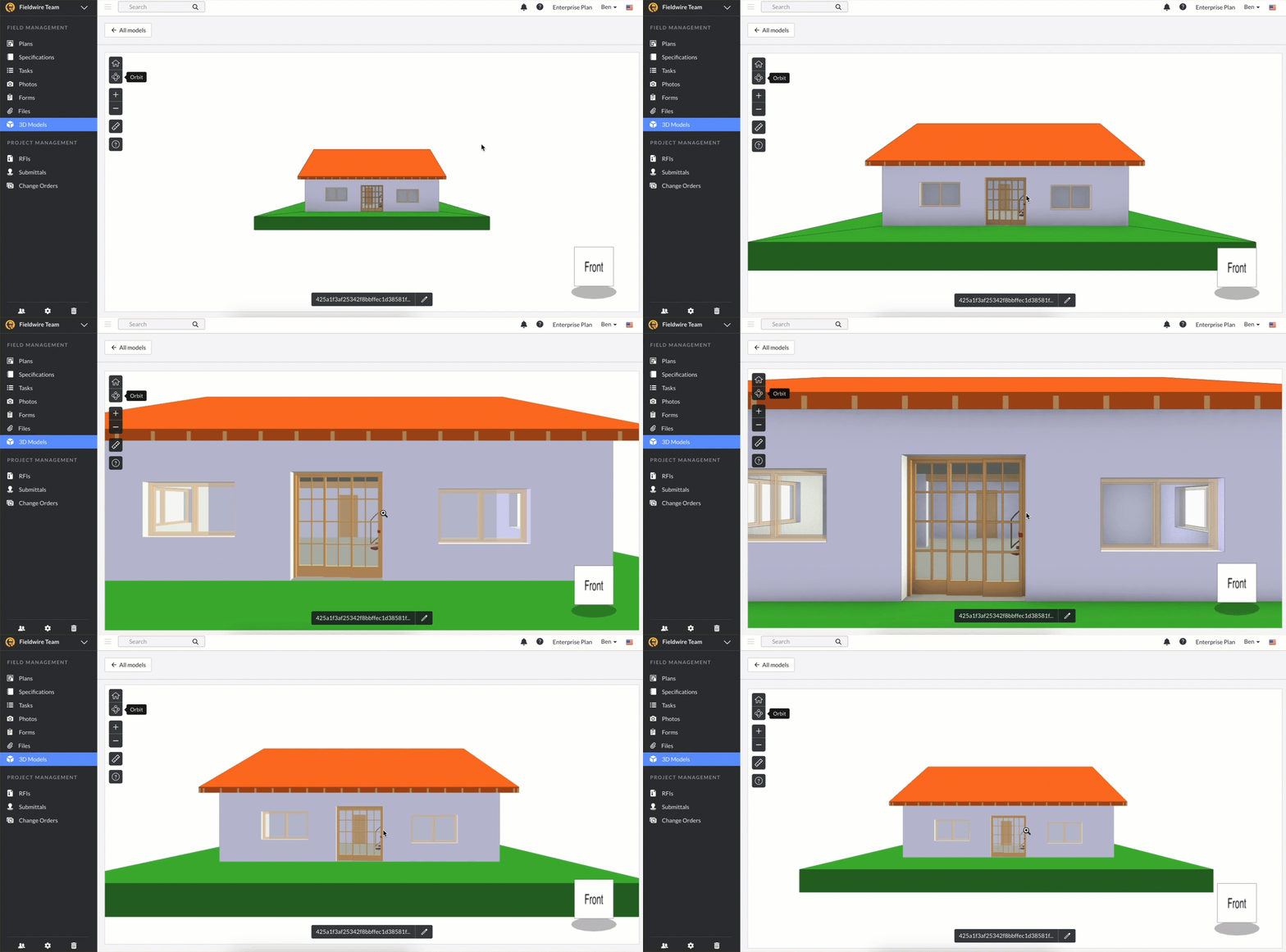
The Walk Tool
Selecting the Walk tool lets you navigate through the model through a point-of-view mode by clicking and dragging towards the direction of your choice.
To Look around:
| Mouse | Trackpad | Keyboard |
| Left Click + Drag (Up, Down, Left, Right) | Press + Drag w/ 1 finger (Up, Down, Left, Right) | Use the arrow keys (Up, Down, Left, Right) |
To Pan:
| Mouse | Trackpad | Keyboard |
| Right Click & Drag (Up/Down/Left/Right) | Right Click + Drag w/ 1 finger (Up,Down, Left, Right) | Select 'A' or 'D' to move left or right. |
To Walk In/Out or Left/Right of the model:
| Mouse | Trackpad | Keyboard |
|
Scroll Wheel Click + Drag: Up/Down to go In/Out Left/Right to go Left/Right |
Swipe w/ 2 Fingers Up/Down: Up/Down to go In/Out |
Use the 'W and 'S' keys to go In/Out. Use the 'A' and 'D' keys to go Left/Right. |
To Zoom In/Out:
| Mouse | Trackpad |
| Scroll Mouse Wheel Up/Down | Swipe w/ 2 Fingers Up/Down |
The camera will zoom to wherever your cursor is located:
The Navigation Cube
The navigation cube in the bottom-right corner is another way to view different areas of your model.
The cube will function differently depending on the tool (orbit or walk) you have selected.
The Navigation Cube and the Orbit Tool
The model will rotate whenever you use the navigation cube while the 'Orbit' tool is selected.
| Mouse | Trackpad |
| Left Click + Drag (Up/Down/Left/Right) | Press + Drag w/ 1 finger (Up/Down/Left/Right) |
The Navigation Cube and the Walk Tool
Whenever you use the navigation cube while the 'Walk' tool is selected, you can shift perspectives within the model.
| Mouse | Trackpad |
| Left Click + Drag (Up/Down/Left/Right) | Press + Drag w/ 1 finger (Up/Down/Left/Right) |
The Sides of the Navigation Cube
If you click on a side of the navigation cube, the model will always reorient to display the selected side, regardless of whether you have the 'Orbit' or 'Walk' tool selected:
You can also select the top and bottom, as well as the corners of the cube to re-orient the view:
Help Icon
If you need to review the navigation controls for the BIM Viewer, choose the Help icon at the bottom of the navigation tools.
To return to the BIM Viewer, click the 'Esc' key, choose the 'x' in the top-right corner of the pop-up, or click the blue "Close" button: